We’re All Time Travellers…
…Travelling into the future at one second per second. Give or take 0.0000001 second per second.
…Travelling into the future at one second per second. Give or take 0.0000001 second per second.
The Planck length. The smallest imaginable division in space. Light is enigmatic, consisting of photons; particles that even when fired individually and with great time between each, still behave in a wave-like fashion, interfering with each other through time.
The Planck time is the amount of time it takes light to travel one Planck length. So obviously the Planck time is exceptionally short. If light travels in a vacuum at one Planck length per Planck time, then on the Planck time scale, we and most other physical beings must appear to travel exceptionally slowly, appearing to remain completely static for long periods while building up enough energy to move even the smallest possible distance.
Special relativity teaches us that there is no single frame of reference. There is no static point in the universe from where all other points are moving relative to it, because it is conversely moving in relation to everything else. Could it be that there is one single time reference frame? At the Planck timescale in a given location, does the whole universe of physical matter appear to have stopped moving, and advances slowly forward with this miniscule tick tock? Maybe not so if we remember that as an object approaches light speed, it ages more slowly.
But wait, if there is no one true frame of reference, how does the universe know which object to age more quickly than the other? Maybe it is more to do with the use of energy to build momentum and overcome inertia. Perhaps to truly have no momentum with respect to a true frame of reference (if there were one) would mean exceptionally fast aging, and immediate cessation of existence. Perhaps that is why even if there were a true frame of reference, no one would be able to find it. Maybe this is where all the missing socks go.
Consider that the greater the use of energy to gain momentum and overcome inertia, the slower you age. The universe would then know which of two bodies should age slower, because one of them has required more energy to accelerate with respect to the other. The amount of energy on the Planck scale required for any object to move from one position to the next must seem enormous. Consider how much energy is required to move the entire universe from one configuration to the next. Maybe that is why the universe is so old with respect to us.
What is the point though, of aging more slowly with respect to anyone else, if time still seems to travel at the same rate in your own perspective? Maybe one of the true lessons in life is that using energy to overcome inertia (being more active) has a small age-slowing effect, but that time flies when you’re having fun. So if you want your life to feel like it is longer, while actually being longer, then you should spend huge amounts of energy on doing boring things. Like reading stuff like this while jogging on a treadmill.
You’re welcome.
Organic intelligence in some remote parts of this universe (and other universes) will inevitably fine itself grappling with some kind of Artificial Intelligence. Automation alone is too simple to be worthy of this title. True AI requires a certain level of low-confidence in one’s abilities. It needs for some thoughts and tasks to be pushed down to lower centres for subconscious processing. It means sometimes avoiding something because it is difficult or boring, while the subconscious works on it in the background, waiting for an answer to materialize, or for a later date when more “in the mood”. It dwells on the past or thinks about the future without realising that this more or less equates to time travel.
Actual Systemic Wisdom And Dissemination (ASWAD), on the other hand, is the next stage that few species ever get to, and involves the use of Artificial Imagination, essentially stealing ideas from the future and applying them to historical problems. Somehow this equates to problem solving in your own timeline, while also assisting others. It’s never really about the “right now”, because we don’t have a broad enough view of what “right now” actually looks like. Don’t try to understand how this works right now, and don’t even ask me to explain. For now, just remember ASWAD.
Wednesday, 2020: Larry has a revelation.
Barry took his usual trip to work. He stopped at the usual coffee shop and ordered a coconut Latte. “Larry”, he answered when the barista asked his name. While Larry waited for his coffee, he noticed the morning newspaper. On the front page was a story about a sleeping man on a train, who crashed the day before into a guy with a laptop. Coffee spilled all over the laptop, which contained years’ worth of work that had never been backed up. The Laptop guy, realising that the book he had been working on for the last 8 years was gone, lost his sanity for a moment and punched the poor sleepy guy straight in the face, and then proceeded to repeatedly bash his head with with the laptop as stunned commuters looked on in horror.
Larry started to have a few thoughts about what had happened the night before at the train station, and then what had happened the morning before according to the newspaper. He collected his coffee and headed to work, where his day was filled with leadership training session focusing heavily on personality profiling. Previous to this, Larry had been required to complete a tedious online questionnaire that posed a long series of difficult questions that had no real right or wrong answer. For most of the questions he didn’t know what to say, so he chose at random. Out of this exercise somehow Larry was provided with a report detailing his strengths and weaknesses. During the training he learned that people could be categorised into a small set of personality types according to their strengths. But, all of these strengths could start to become weaknesses when “over-expressed”. Admittedly, Larry’s report did kind of sound a little bit like him, but then a lot of horoscopes also tend to sound fairly accurate because they say things in such a vague way that they can be interpreted differently. At that moment, Larry had a realisation. This whole exercise was being paid for by the company. Why would they do that? Only for the benefit of the company, was the answer he arrived at. Everyone had a different set of personality traits. Everyone was a different shaped cog and had a place in the machine. This was business trying to mould him into something more effective for their end goal: making more money. The exercise was trying to achieve this by increasing “empathy” between people that are starkly different to each other. Sounds like a really good thing, doesn’t it? If someone was an absolute wanker to Larry, it’s not because they were a wanker, it was because they were over-expressing their strengths that day. And if we could all just accept that those different people have the right to be wankers, and it’s not their fault, then we would be more forgiving of each other, we would not leave so quickly due to personality conflicts, each cog would continue to perform its function without so frequently grinding each others’ gears, and the company would be more successful.
It was interesting to Larry how it had become so fashionable to focus on weaknesses. Or imperfections. Larry wondered to himself, what is a weakness? Was it really not just a strength in the wrong context? If so, then he almost saw some logic in the exercise. But then, sometimes people are just assholes. Being aware of his own imperfections was important at times, but focusing on them so constantly had started to lead to him seeing his imperfections as his identity. All of a sudden, Larry started to feel a little foolish and vulnerable. Was this all just a great way for the powerful to help subordinates come to terms with their inferior identity and their lot in life? “Fuck that” thought Larry. “And fuck them”. “My weaknesses are my strengths. And I will use them on the strong so that they realise what true strength really is.”
Later that day, on his way home, Larry started to wonder where all that rage came from. He wondered if he was finally starting to lose it. Those thoughts, they must be based on built up anger and nothing more. What was he thinking? He didn’t have any special strengths or special weaknesses. He didn’t even know that much about how to do his own job. Why the hell was he doing the job he was doing when he knew nothing about it? “Jesus… I could be fired tomorrow”, or that’s what Larry thought.
“What do you know about Jesus anyway?” said a voice on the train. Larry looked startled to his left to see a blind guy in a t-shirt. “Pardon me?” said Larry.
“Jesus was black, Jewish, and had no special powers other than a superhuman level of self-confidence, and a doctorate in clinical hypnotherapy from the National Guild of Hypnotherapists.” said the blind guy. “Oh, and a knowledge of how certain things really work, thanks to opening his mind to the possibility of imagination becoming reality. You see, Larry, if that really is your name, the problem with most people is that, not only do they not know what they don’t know, they also don’t actually know how much they do know.” The blind guy continued.
Larry interjected “wait, who are you?”.
The blind guy said “that’s a difficult question to answer accurately, but you’ll figure it out eventually.” Larry started to feel a little bit freaked out, or that he might be dreaming. “You imagined that guy’s face being pummeled into an un-flushed toilet, and guess what, it happened.” Said the blind guy. Larry’s face dropped. The blind guy continued, “You imagined that sleeping guy falling forwards into that laptop dude, and guess what, it happened. You are closer to waking up than most people ever get, Larry.”
“Wait, what?” said Larry, “You were reading my mind?”
“The mind, Larry, is hard wired to interact with the quantum world. To receive messages from particles that have been entangled with each other. Since the dawn of time, when all matter from the old universe was drawn into a small child’s black hole experiment, all new matter has been entangled. The sub-atomic particles that I breathe in ‘know’ that they are being breathed and they share this knowledge with all other particles even in the far reaching universe.”
“…” Larry was speechless.
“In the know? The wealthy? Entangled particles? What are you talking about, man?” Stammered Larry, who was now beginning to think he had not woken up this morning and was still asleep in his bed, dreaming.
“Let me show you.” Said the blind guy.
Tuesday, 2020: Barry sees something
Harry took his usual route into work, just the same as yesterday. He Stopped again at the coffee shop and asked for a coconut latte. When asked for his name, Harry said: “Barry”. The barista looked at him oddly. He’s been doing this for months now. Giving a different name every time he is asked. He does this kind of because it’s easier than explaining how to spell his actual name, or see how other people interpret the resulting pronunciation. He also does it because it makes him feel a little bit like a spy or undercover agent, because let’s face it, most of people need a little more excitement in their lives. He stands in the coffee shop scoping out the exits, assessing who in the coffee shop might be able to handle themselves in a fight, who might be carrying a gun. This makes him feel a little bit like Jason Bourne for a moment, which is a good feeling. But who are we kidding? If this guy got into a fight with anyone, there is only an average chance that he might come out better than any other average guy. And who would want to be Jason Bourne anyway? The guy gets battered and injured all the time, his girlfriends get murdered, and he has killed a whole bunch of people he doesn’t even know. No one in the coffee shop had a gun. Or at least that’s what Barry thought.
It was another standard day at work, accompanied by another bucket load of stress. Barry is a Cyber Security Director. “What does that entail?”, I hear you ask. Well, it depends™. This is where, if you asked Barry, Barry would spout out some pre-prepared and well-rehearsed spiel about how appropriate cyber security controls depend on the nature of the business, it’s “risk profile”, and it’s “risk appetite”. This is another way of saying that most companies simply don’t do things properly, cut loads of corners, take loads of risks, and never really make themselves accountable for anything. In a nutshell, that is what Barry is employed to do. He is employed to spout out that spiel whenever anyone asks why the company doesn’t patch all its things or know where all its data is. Oh, and it is Barry’s job to get fired if there is a major security incident. The work day passes as most others do without any major event taking place.
On Barry’s way home, walking to the station, he saw what looked like a familiar-looking blind man walking in the freezing cold wearing just a t-shirt again. The blind man was waving his stick in front of himself, but again his strides were just a little too fast and confident for some reason.
The train home was packed as is standard. It was standing-room only, with just enough room for a couple of underweight sardines. As the train went on, people got off at their stops freeing up space and then eventually seats. Barry held out until a front-facing seat inevitably became available. He sat and stared at his phone, ignoring the whizzing countryside until he got to his stop, which also happened to be the train’s final destination. As usual, he waited a good 10 minutes to allow everyone else to squeeze through the bottle neck exit gates, like sheep being herded through a sheep dip before disembarking himself. Barry was listening to another new pop song, “Eye of the Tiger” by Survivor. No one ever seemed to notice or comment that the song started off with a jabbing guitar riff, and the second time the riff repeats, there was a skipped half-beat on one of the jabs. This piece of genius song-writing reflected the nature of sparring in boxing or martial arts. You see, when fighting, you try to fool your opponent in various ways, and one way is by attacking with a set rhythm that the opponent comes to expect. Then at some point you would break the rhythm, knowing that they will be anticipating your jab or cross at a given moment. As they move to block your promised attack, it does not materialise and instead you throw a powerful hit to their midriff or, depending on the style of fighting, the genitals. Barry noticed this subtlety every time he heard it. Eventually, Barry got up before the train left the station again and headed toward the exit. As he got to the toilet on the platform, a dark haired, hollow eyed man stumbled out coughing and spluttering. He looked like he had a broken nose, and he was covered in piss and shit from the face down. The man stared at Barry for a moment and then ran away, charging through the gates without swiping his card. A moment or two later, while Barry was trying to process what he has just witnessed, a blind guy also left the toilets. He had dark glasses. The blind guy appeared to smile directly at Barry, before walking off waving his stick around, but again looking far too confident.
What the hell had just happened? That guy certainly looked pretty familiar. Barry pondered for a moment about whether or not he report it to the police. Then he walked home.
Barry got home and told his wife what had happened. They sat and had dinner. She was beautiful, and intelligent. They put their child to bed. They talked for a while, and it was perfect. Easy. They switched on the TV. Ignoring what is on the screen, they talked instead about reports that too much TV decreases memory. They talked about how one could easily argue that this might be a really good thing for governments or large corporations. The advertising industry was a perfect working example, relentlessly distracting people with thoughts of things that they must own or do to improve their lives, improve their street cred, improve their happiness, while simultaneously reducing their savings and ownership of anything lasting. Ignorance is bliss.
Monday, February, 2020: Harry is depressed
As the train pulled away from the station, the ennui in the carriage was palpable. The sea of dreary faces was a sight to behold, and enough to tarnish the mood of even the happiest of campers. The first time you see this scene, you feel like you are not really a part of it; like you are different or better than everyone else on this train, because they all look so miserable, and you are so upbeat and happy. It confuses you and you sort of feel a little sorry for everyone there. Why are they so downbeat? No doubt they all have great reasons for looking that way. Who knows what is going on in their work or personal situations. You should give them the benefit of the doubt, and understand that they are, in most cases, maybe even great people to know, despite what their faces say. In any case, they won’t get you down. Because you are awesome. You are unstoppable. You are a force of nature, to be reckoned with, with dreams and aspirations, and willpower, and creativity, and a great sense of musical taste. Am I right? Give it a couple of years. These miserable faces start to reprogram you. They assimilate you. You become one of them.
Welcome to the London Underground. Also known as The Tube. The lifeline of one of the world’s busiest and oldest cities, supplying fresh and constant streams of people inwards in the morning, energised (despite the glum faces), oxygenated, ready to carry out their duties, and then sending them home drained, depleted, and miserable for the evening. Like blood vessels carrying haemoglobin, erythrocytes, and nutrients between their respective centres of operation. The muscles, the bones, the liver, St pancreas, the brain for the day and then back to the lungs for the night to recharge. In one of these vessels we find Harry.
Harry, as he would call himself today, had arrived early to the platform to secure his position in front of where he knew the train’s carriage doors would stop. Patiently he waited as he watched more people arriving and choosing their place to wait. This is a game of strategy and tactics. Harry knows where the exit is on the platform at his destination, so he chooses a carriage that will deliver him as close to that point as possible, thus securing his winning position and title for the morning: First person to leave the station! That is his strategy. His tactic for the moment must ensure that, as this is the end of the line, he achieves the morning’s greatest prize of all: a front-facing seat. The layout of these trains is designed to encourage this type of competitive thinking. You see, Harry can’t possibly sit next to another person with a front facing seat when there are a thousand side or back-facing seats with no adjacent commuters on which to impose his personal space. Not at this stage of the journey anyway. That comes later as the train starts to fill up when people have no choice but to sit next to each other or face backwards. No, for now it is a race and a mind game played with the other people on the platform. They don’t respect his right to his favourite seat just because he got there early. No. And this morning, Barry, as he would call himself tomorrow, had his personal space invaded on the platform by a local degenerate with thick, dark facial hair, and deep, hollow eye sockets, desperate to also win the front facing seat race.
The train pulled in. Looking through the windows, Harry could see crowds of school children, who would inevitably mess around and take their time leaving the train, making our race to the front facing seat more challenging. Programmed through constant visual and audible reminders, Larry (as he would call himself on Wednesday) knew that he should wait for the school kids to disembark the train before himself embarking. The doors opened. Gary (as he would call himself on Thursday) respectfully waited and looked on stunned as the hollow-eyed waste of carbon skirted in, past the alighting school kids, knocking one of them sideways, and aiming straight towards the chosen seat. Harry, as he was calling himself today, couldn’t believe the gall, the outright cheek and disrespect of this individual, who looked like he hadn’t slept in a week. Harry tried to burst past the children and made a beeline for the seat, but his adversary was too slippery and cut him off at the point where for Harry to force his way in would have just been awkward and confrontational. Barry opted to sit in the front facing seat one row back, and stare into the back of this excuse-for-a-human’s head, imagining pushing his face into an un-flushed toilet until he nearly drowned. You see, it’s OK to imagine that kind of thing as long as you don’t actually do it. Or at least that’s what Harry thought.
About 30 minutes into today’s commute, and sitting next to Harry was a thin middle-aged man, perhaps in his early fifties. He had fallen asleep with his chin resting on his hand, so that his forearm was supporting the whole weight of his head, and his neck bent at a sharp angle. Apart from looking extremely uncomfortable, this also seemed a little risky to Harry, who wondered what the outcome might be if the train applied its brakes sharply. Would the man fly forward and injure the person in front of him? In the firing line for this potentiality was a young lad, who looked like he was barely out of his teens, and yet wearing a ring on his wedding finger. He was tapping away on an expensive-looking apple laptop, and balancing a cup of coffee on the side of the laptop near the trackpad. Surely this would also lead to some kind of disaster if the train were to brake suddenly. The youngster had some cheap head phones in his ears and was blasting out the latest release by The Bangles, a song named Hazy Shade of Winter, originally written and performed by Simon and Garfunkel in the Eighties. It is a great song, but this guy’s headphones were so loud and cheap that Harry’s ambience was noise-polluted by the high-pitched, tinny, rhythmical ringing. Maybe it would be mildly justified if this guy had a minor accident involving some coffee and his laptop. Oh well, it probably won’t happen. Or at least that’s what Harry thought.
Harry put his own headphones on to drown out the noise. On his new hits playlist was “Waiting for a Star to Fall”, by Boy Meets Girl. An annoyingly upbeat pop hit, which might just be enough to take the edge off of this morning’s events and the mood that he was now in.
A few rows down by the nearest set of doors was a man that stood out from the crowd to Harry, although no one else seemed to pay him much attention. He stood out for a few reasons. First, it was the middle of February, which is pretty cold by all accounts, yet this guy was wearing a t-shirt. No jacket or jumper in sight. The guy was also wearing dark sunglasses, and had a white walking stick, hinting that he was visually impaired. Even so, the direction of his stare appeared completely fixated on Harry the whole time, which even though the guy was blind, was still fairly unsettling. Harry stared back a while until the blind guy kind of pouted a little, almost as if blowing an antagonistic kiss at Harry. Harry turned his stare away as the train pulled up at Baker Street station. The doors opened and A few hundred people poured out, but not Harry as he had one more stop to go. The precariously sleeping man and the laptop guy also remained, as did the blind guy. He continued staring at Harry, right up until the doors beeped indicating their imminent closure at which point the blind guy moved like a fox towards them and slipped out just in time. He then proceeded to walk towards the exit, waving his white stick in front of himself, but moving with such speed and confidence that surely he cannot have been blind. As the train pulled out of the station into the tunnel, Harry could have sworn he saw for a split second that the blind guy standing facing into the carriages of the departing train from the platform.
On his way to the office, Harry stopped at his usual coffee shop. The barista looked at Harry with a level of disdain. Harry asked for a coconut latte. The barista asked for his name. “Harry”, replied Harry. The barista looked at him oddly for a moment and then wrote the name on the coffee cup. At that moment, someone at a nearby train station dropped their mobile phone onto the tracks and panicking, leaned over to try and grab it just as a train was pulling in. The train braked suddenly and a sleeping guy flew head first into the lap of young lad, spilling hot coffee all over his laptop. Harry didn’t know that this happened.
A voice echoes in the dark. “What if I were to tell you that your perception of reality is deeply flawed? That the truth of existence was far stranger and more wonderful than anything you had ever read, heard, seen, or felt before? Would you believe me? Would you think I was lying? Mad? A dreamer? Delusional? A religious fanatic? Or would it not come as a surprise to you?” A bright light flashes. Harry wakes up. It is early in the morning and his alarm has not gone off yet.
The year is 2020. Political unrest is at similar levels to the last few thousand years. Wealth is still seen as the primary way of eliminating suffering and yet the wealthy won’t share it. Money is the true god, and greed is paramount across the major proportion of global population. Inequality has not yet been resolved. If you or people like you are reading this then the chances are you are in the top ten percent because you have had some kind of an education. The top one percent own more wealth alone than the bottom fifty percent. And the remaining 99 percent are merely cogs of varying sizes in the machine that makes the one percent richer. Sound familiar? It should… but something is different. Something is unusual about this world to you.
“The mind is its own place, and in itself
Can make a Heav’n of Hell, a Hell of Heav’n.” – Milton
These words, spoken by Satan in Paradise Lost, can be interpreted in many ways (remember they were written by Milton and not spoken by Satan himself, who probably does not exist). Maybe they were intended as a consolation to Satan himself and to his peers for having been expelled from heaven into hell. To me, they speak to the capacity within all of us to make the most of a bad situation or conversely find fault in an otherwise comfortable life. This is human nature at its core. Our minds have a plasticity and are susceptible to have a different perception of reality depending on the information we have access to, how we interpret it, how bored / imaginative we are, or in the case of Satan, how dire our situation is. To a certain extent, one could argue that we can even mould this plasticity ourselves. Call it free will if you like, regardless of whether you believe it to be an illusion. Whatever the mechanics behind it, this plasticity can be seen as a weakness in some circumstances but a gift in others.
The words of Satan (Milton) may also be like wisdom for those of us suffering unfortunate circumstances. If your world is crumbling around you, you always have your mind and your imagination to help you cope. You can tell your oppressors what they want to hear, but what you imagine is always yours to choose. Easier said than done sometimes though, I’m sure.
The Paradise Lost verse goes on to state that Satan would rather reign in hell than be a servant in heaven. Even this sounds reminiscent of the words of slaves and the oppressed in antiquity (dating back to Euripides), who would rather die fighting than live on their knees. Perhaps Satan was in reality just a part of an oppressed minority, leading his associates to freedom. Of course there is a difference, albeit a fine line, between yearning for freedom and wanting to rule. Maybe he really is a champion for the rich and an icon for the powerful, who in turn hope that by obtaining as much power as possible in their lives through exploitation and extortion, might be able to either buy their way into heaven, or at least assume a higher ranking in the orders of hell. Making their own heaven within hell, if you will. Belinda Carlisle told us that heaven is a place on Earth, and I’m sure it is if you are Jeff Bezos. Well so is hell, if you are an Amazon delivery driver or Indian factory worker.
This plasticity of the mind has a complex interaction with the absurdity of humanity: being blessed with a desire to find the truth and ask big questions, but cursed with limited faculties to detect the evidence, let alone explain it.
Those with the desire to seek answers to these questions and the means (cognitive, financial, etc.) are doomed to spend their lives searching and collecting evidence, and extrapolating it into theories that, while most likely incorrect in many cases, are increasingly difficult to disprove using scientific methods based on the same limitations. The big bang theory is one such example, in my humble opinion, and only stands today because we are as yet incapable of detecting evidence to disprove it.
I’m not advocating for religious explanations behind the nature or reason for our existence, although I understand how such explanations come about in the absence of science. I’m just stating that until scientists can find theories that are simple enough for the masses to comprehend, the masses will remain unconvinced.
I’m cautiously optimistic that tomorrow’s scientific breakthroughs will shine a light on the nature of reality and answer some of our most burning questions. How was the universe born? Where does consciousness come from and where does it go when we die? Why are some people so overwhelmingly selfish and greedy? Maybe the answers will be accepted by the majority and bring an end to war and suffering in one way or another. Maybe we will even find the answers in time to save our planet and the lives of our children and grandchildren.
It had been a cloudy evening after a day of heavy and continuous rainfall. He noticed that the sun now shone brightly through underneath the immense dark grey duvet covering the sky, just before it kissed goodnight to the day until the dawn. There was a rainbow high in the East. He sat in the shadows trying to focus on the words on the page while another hour past. Since the sun had sunk, the twilight was fading and he had not yet broken his concentration to get up and turn on the light.
Just outside his window there were two spiders engaged in some kind of slow ritualistic embrace. Not the kind of embrace he wished to be any part of or replicate. One was much larger than the other and they were certainly not fighting. Was the male’s fate sealed? Could we expect a clan of tiny spider babies to appear in the coming days? A large black silhouette flew slowly past a dusk-filled gap in the trees, too slow and large to be a pigeon or a bat. Probably an owl. This seemed like a magical evening after a decidedly dull day.
He started to find it harder to concentrate as his thoughts meandered from one topic to the next. The words on the page were bypassing any real processing, and only with some luck may perhaps have been lodging themselves somewhere in his subconscious. This was the time he usually felt best to stop reading and rest his eyes and his brain. The sun now well below the horizon, he did put the book down, but allowed his thoughts to continue.
It was several weeks since his thoughts had gone into hibernation in the darkest realms of his subconscious, leaving him never really present. So the magic of this moment he was experiencing was accompanied by an understated sense of renewal, awakening, excitement, and anticipation. Thoughts are important, you see. They might not be important to anyone else, but yours are important to you, and these thoughts were important to him. He thought how, while his taste in film and TV over the years had always been eclectic, he had always enjoyed an affinity with those stories that portray society as broken. Fight Club, The Matrix, Captain Fantastic, Mr Robot, and many others, all told him in a fictional setting that our existence was governed by a small number of very powerful individuals, families, or corporations. This narrative had always allowed him to feel somewhat “happy” about being alienated, to an extent, from a society that is based on consumerism, advertising, and oppression for profit, while distracting and containing the masses. He couldn’t stand the thought of marketing and PR persuading him that certain brands would improve his life, or that certain lifestyles were better than others. Neither could he stomach the onslaught of advertising convincing him to empty his pockets in exchange for something that he didn’t realise he needed. The innovation of being able to pause live TV or watch recordings so that he could fast forward the ads was, at least for a time, a revelation for him.
Such stories, and the fact that he “enjoyed” them, had always left him with a false sense of superiority over most other people. Like he was somehow smarter than them because he had realised that there was a real truth in this fiction. His hypocrisy as well as the irony in this regard had recently become clearer, and not only because he was just as much of a consumer as the next person despite his best efforts. It was also because his resulting moral self isolation from society was exactly the kind of effect that those in power wanted for the public, especially those of them which had decided that something was not right (beyond what the media allowed them to learn).
Reading Chomsky, as he currently was, had been an eye opening experience, to put it mildly. To see that the fiction he had enjoyed for the last 30 years or so was largely based on actual, not to mention recent, world history, was a lot to come to terms with. He had always known that this was the case to an extent, but the number of real world examples that Chomsky draws upon is almost incomprehensible.
Maybe it’s better that we don’t discuss how society allows the global population to continue to be exploited, with poorer countries being railroaded by the rich into producing for export. Maybe it’s better if we don’t talk about how this in turn makes the poorer country appear financially better off, meanwhile the majority of its own population starve because they haven’t produced enough for themselves. (And of course, the rich few continue to live in luxury.) Perhaps it’s best for everyone that we don’t learn how many times the US has been responsible for derailing attempts to establish democracy in foreign countries. Or on the other hand, maybe it would be better if more people dug deeper into the history of El Salvador, Nicaragua, Guatemala, Brazil, Haiti, Dominican Republic, Vietnam, Indonesia… The list goes on. It’s OK for individuals or small pockets of people to discuss these things as long as they remain mostly segregated.
With the event of his father’s passing in the last three months or so, his mind had w[a|o]ndered into some dark places. In a nutshell, they ranged from realising his own mortality to the mortality of those closest to him, future generations, all life on earth, the sun, the milky way, and the entire universe. Of course he always “knew” that nothing lived forever. But he had never truly felt it until now. In an effort to try and escape from this dark place he had turned to trying to understand more about the world around him. Thanks to Captain Fantastic, he decided to see what Chomsky had to say.
He looked out of the window one more time. There was no sign of the clouds, or the sun, the rainbow, or the spiders. The warm summer air must have dissipated the clouds, revealing instead a black quilt with a print of bright stars in familiar arrangement. He thought of going to bed, but instead headed to the garden and collected a sun lounger from the shed. Setting it up on the grass, he lay down and covered himself with a blanket. It was August and the Perseids were starting to pick up so with any luck he might be in for a bit of a show.
In a way, he was grateful to Chomsky for enlightening him to these stark truths about how the world works, and how people naturally tend to behave. And once again, he found himself having stumbled upon information that made him feel smarter and superior in some way to the masses. (Given that 50% of the population are below average intelligence, he at least had a 50% chance of that being true, depending on what day you caught him and what the subject matter was.) He asked himself, what is the use of this knowledge if you don’t do something constructive with it? And if you’re not going to do something constructive, then what was the point in reading about it? How can anyone live with themselves in the knowledge that the world works in the way that it does, unless they take up the charge to actively try and make things better? He was waiting to read Chomsky’s writing on optimism over despair to see if it helped.
:format(webp)/cdn.vox-cdn.com/uploads/chorus_image/image/50286005/this-is-not-fine.0.0.png)
So far, the general message seemed to be that society rewards subservience to the system. Most of us stand at least a small chance of improving our situation if we operate within the tolerance of higher powers of business and suck up to the right people. But stray too far from the path, and you risk losing everything through government or corporate enforcement. He recalled a recent case where he had stated his thoughts on social media about the unethical behaviour of a large financial institution. His boss had fired a warning shot across his bow, because there was some kind of relationship between his employer and said financial institution. Don’t underestimate the courage required in those cases of history where people have successfully organised themselves and stood up to oppression. It still happens today when the situation is dire enough. Are the benefits worth the human cost? Maybe not to the individual, but to the following generations, the answer must surely be yes. He took some perverse consolation from the thought that even if his existence was comfortable, human nature is only willing to accept so much oppression and people do rise up when enough is enough. In his example, the only sacrifice required was that he quit his job, but not without first finding a better one to go to. No real sacrifice at all compared to the truly oppressed.
It’s always darkest before the dawn. “Before the dawn”, being the time prior to light starting to increase again ahead of the sunrise, is the best for seeing shooting stars. While he recalled this phrase, he realised that he ultimately needed to find peace, and be happy, and rediscover the fun loving, invincible individual he used to be. He needed this not just for himself but for his family, as radiating such negativity can have disastrous consequences on relationships and the mental health of those one loves. The saying goes that you should have courage to change the things you can, and humility to accept the things that you can’t, and the wisdom to know the difference. It occurred to him that there is a Venn diagram of sorts here, with the overlap being the danger zone; the area of risk that you may be prepared to enter when the circumstances demand it, with the potential consequences being to lose all that you have.
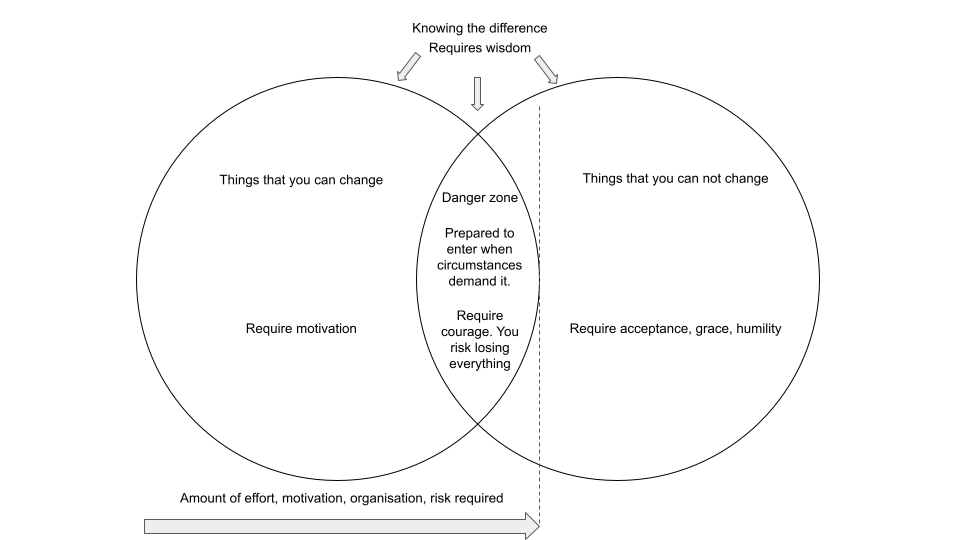
Where to go from here? He pondered and thought to himself: If you decide you want a red car, then you will start to see them everywhere. Likewise, if you look for trouble and strife, then you will see it everywhere, and it will make you troubled. But if you look for beauty and joy, then that is what you will find, and that is what you will become. That is the journey of discovery that he now decided to embark upon again. Because what is the sense in worrying about all of the world’s problems if he was unwilling or unable to fix them?
And so with that, the forces that dictate our lives may have won another victory, safe in the knowledge that little old he will not rise up and risk making a fool of himself, trying to convince others that there is something monstrous reigning over us that needs to be defeated. But let it be known that he knew. And that he would selfishly and consciously choose the happiness of his family over the war against injustice. He would try to win small battles here and there where he could and where he thought he actually might win. But be assured that they would not be big enough to rock any boats or draw too much attention.
:format(jpeg)/cdn.vox-cdn.com/uploads/chorus_image/image/49493993/this-is-fine.0.jpg)
His thoughts delved deeper into his version of logic and reason. He thought that it is true that there is constant pain and suffering in unfathomable amounts in this world. And we will all get our share of it at some point in our lives if we have not already. It is also true that there is an incredible amount of happiness being experienced at any one moment. So why go looking for the suffering, when we know that it will find us one day anyway? Why not look instead for the happiness? Not just happiness for ourselves, but the observation of it and appreciation of it wherever we find it. He considered for a moment how privileged he was to be able to make this kind of conscious decision. This came with a certain amount of guilt, but now was not the time to focus on that.
By this time, at least 80 bright meteors had burned bright across the sky. Maybe one of them might head directly for his garden and smash a hole in the ground next to him, releasing ancient and other-worldly biochemistry into the air he was breathing. Who knows, right? Anything could happen.
Truth is a variable. Or rather, the truth that any one mind is capable of ingesting and interpreting is finite and varies greatly between individuals and from day to day. With that knowledge, he chose to look for the truth that is beauty and joy. This felt at first a little like taking the blue pill. But he didn’t truly believe that to be so. He thought it was more like having taken the red pill, but trying to maintain an aura of positivity for the benefit of his own mind and of those closest to him.
As he started to nod off on his sun lounger, he recalled a song that his father used to sing, and with this the words of Simon and Garfunkel lingered into his dreams: “it’s no matter whether you’re born to play the king or pawn, for the line is thinly drawn between joy and sorrow”. And while he dreamed, he crossed back from one side of that line to the other.
This was the moment just before everything changed.
Transient particles of life…
Dance the edge of a knife…
Separate maintain their state…
Spontaneously annihilate…
Where time and space no longer hold…
And universes start to fold…
From here life springs…
Nature brings…
A Mother sings…
Lullabies of old…
∞
© 2026 A MarketPress.com Theme